

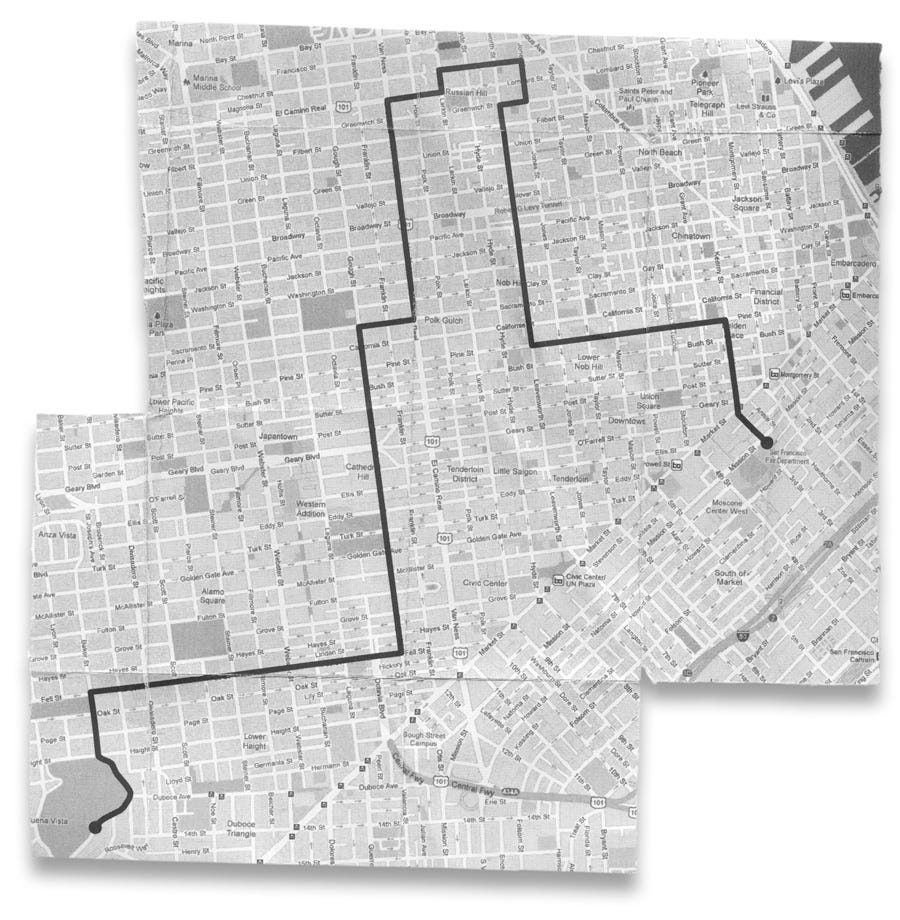
They were a bit tipsy as they slid into the backseat of my cab in front of the St. Regis Hotel. Two women in their forties—a blonde with a blue scarf who wanted to go to Russian Hill, and a brunette in a short gray jacket who was going someplace further. It was a Friday night about Ten, and their topic was how everything was wrong with a woman named Ava.
“She really gets on my nerves,” the gray jacket complained.
“That’s because she just can’t stop talking about herself and how wonderful she is and how young she looks!” the blonde said.
She tried to get her seat belt to snap into place as she held forth.
“I’m just—your neck looks reptilian, Honey! You do not look that young and you are not that pretty!”
The gray jacket let out a giggle, but the blonde wasn’t done.
“Maybe you think you’re pretty. You’re a pretty reptile. You have ten miles of crow’s feet to match your wrinkly old neck!”
Without pausing, she addressed herself to me.
“Sir, I know you think we’re horrible, but she really does have this awful face, and fifteen minutes ago she was telling me, No you don’t understand, this twenty-seven-year-old wanted to go home with me! And I said, Where’d you meet him? And she said, At the Balboa. And I said, It’s in the guidebooks honey. He’s looking for cougar and you just cougared up!”
“Maybe I’ll go to the Balboa to see for myself,” I said.
“Sorry. You’re too old for her apparently,” the blonde said.
As we drove up Kearny Street, a businessman, leaning on his suitcase handle, tried to hail me with his free hand; and on the next block, four Asian girls in matching black skirts and stockings, beckoned with slim arms. I felt jealous about all the fares I couldn’t have.
We took Pine up the hill and then turned right at Leavenworth and Ava turned out to be only the first of several women to be skewered. When we got to Greenwich Street, I wanted to know where to stop.
“Halfway up the block,” the blonde said. “I’m the striped awning.” She gestured toward her friend. “And this one’s going on and she’ll be nice and quiet because she’s not mean and catty like me.” But even after the ritual refusal by the one going on of the one getting out’s money, and after it had been properly received with a little pout, the blonde, who was now standing on the sidewalk, went on talking with her head just inside the door.
“And her dress,” she said. “She’s not one second younger than either of us. Isn’t it amazing that she’s trying out for cheerleader!”
“Let me let this nice man take me home, Doll,” the lady still inside the cab said.
“You’re right. See what happens when you get me started? Next week, okay? Kiss-kiss!”
And with that, the door closed and we both watched her walk resolutely through the entrance, squeezing the life out of her pale blue purse.
“Oh my god. These people! These women! It’s really too much!” my remaining passenger said as we pulled away.
“She’s funny,” I said.
“We do have a good time. We do! But women are just so vicious. They’re more vicious than men, don’t you think?”
“I don’t know,” I said. “It’s hard to say. Where am I taking you?”
“Buena Vista East,” she said. “I’ll show you which building when we get there.”
The drone of the engine put a hold on any further discussion as we climbed the steep hill on Chestnut Street. At Hyde, we clattered over the cable car tracks.
As we started downhill, she tapped me on the shoulder. “A bunch of us get together every Friday,” she said.
I looked back at her out of the corner of my eye. She looked like somebody’s boss. Everything about her—the invisible makeup, the hard rectangular frames of her glasses—projected a stylish, corporate distance.
“But now I’m moving back to New York and I’m going to miss San Francisco. I’ve been here for more than ten years.”
“So, why leave?”
“It’s for a job… and I think maybe it’s time. But people keep saying to me: How can you compare this with New York? And you can’t. It’s an absolutely different place.”
“I know,” I said. “I had this passenger tonight, this guy, and he was from New York too. He kept telling me New York this and New York that.”
“Was he visiting?”
“No. It seemed like he’d been here a few years. I pick up lots of New Yorkers, and practically every one of them says—New York’s bigger, faster, better, or far worse, right? Right? Whatever it is, it’s much, much more.”
“Well, I guess I’m guilty of that too. What drove him out of New York?”
“Drove him out?”
“The thing that made him leave,” she said.
“He had all sorts of stuff.”
“Like what?”
“Like, he says—he sounded really sad—Did you know they’re closing the Rainbow Room?”
“Oh, poor baby.”
“Well, if he was a baby, he was a sixty-year-old baby—like the Pillsbury Doughboy with a briefcase. Total New Yorker though, with the accent and everything. He said, Bernaad Meltzaa wuz at the Rainbow Room with his wife Phylis. He goes, He wuz jus comin off the air at WOR and was going on at WNBC—”
She laughed. “He does sound dyed in the wool.”
“But he hates it!”
“Did a fly land in his soup at the Rainbow Room?”
“That must have been it,” I said. “But actually, he had one really horrific night that made him get the hell outta there.”
She got quiet after that. We rolled down Gough Street while she just stared out the window. I wanted her to talk to me. I made a point of cresting the hill at Eddy Street a little faster than was advisable. You feel like you’re flying, and I thought she’d say something.
After the cab stopped rattling, I went ahead and asked her, “You want to hear about it?”
“What’s that, doll?” she said absently.
“The New Yorker’s horror story.”
“This story—it happened recently, right?”
“Like a couple of years ago, I think.”
“Okay. I’m listening.”
So I resurrected the voice. “I wuz at a consit in Madison Squeaa Gaaden,” I said. “It was the Rollin Stones.”
“Got it.”
“And the show ran late, cause Mick waanted to do Sympathy for the Devil. Then he waanted to do Satisfaction, and then he waanted to do anotha song, so the show ran very very late.”
I could hear the vinyl creak. Was I just annoying her?
“He was living on West Twelfth Street,” I said. “He didn’t want to take a taxi so he took the subway. He’s like halfway home when the train stops and the doors open—”
“It was probably Twenty-third Street,” she said.
“And a bunch of rats came swarming onto the train!”
She laughed. “That’s not a reason to leave New York!”
“He said people were screaming. He said they were putting their feet up on the seats—”
“They’re only looking for trash,” she said.
I looked back at her in the mirror. “Big dirty rats!” She was gazing out the window blankly. If she’d been so friendly with me before, it was because of the cocktails. That’s all it was. She was sobering up.
“One of the rats was wearing a little kid’s T-shirt,” I said.
Her laugh felt like a reprieve.
“It had a picture of Mickey Mouse!”
“Yeah, right,” she said.
“But I asked him about those rats, What if the doors close? And he says, They just get off at the next stop.” I turned back halfway around in my seat. “Can you imagine?”
“They probably commute in from Long Island like everybody else,” she said.
That made me laugh.
She said, “It’s called the rat race.”
The story had begun to feel like a collaboration. “It gets even worse after this thing with the rats,” I said. “He gets to his actual stop—”
“Seventh Avenue, right?”
“I guess so. I don’t actually know,” I said. “But he’s the only one who gets off and there’s nobody there. The place is empty. He goes up the stairs and there’s just one guy coming down—a dude wearing a suit. He looks like a professional guy.”
“Lower Manhattan used to be full of businessmen,” she said.
“So this guy suddenly spits in his face and pushes him down the stairs!”
“The professional guy?”
“The guy in a suit.”
“That’s somewhat unexpected.”
“And the bald guy’s on the floor. He’s in a fetal position and the suit’s kicking him.”
“I admit that’s horrible,” she said.
It’s too dark to see her face in the mirror. All I can see is a black blob. “It’s dark around here,” I said.
“Not as dark as New York,” she said with a little laugh.
Fell Street leads to Baker Street leads to the foot of Buena Vista East. We waited for a bus to go by—its interior glowing with yellow light, just a couple of black hoodies slumped in the very back.
“What happened to the guy?” she said.
“He’s lying on the floor, getting kicked in the testicles,” I said.
“Poor man.”
“Yeah. That really hurts, but he manages to roll over on his belly—”
“Just go straight up the hill. I’ll tell you where to stop.”
“I bet I know the place,” I said.
“Finish your story.”
“He’s getting the bejeesus kicked out of him. He’s down in the cigarette butts and trash. But then he gets his hand on an empty malt liquor bottle in a bag.”
“Like a beer bottle, right?”
“Yeah. Like that.” I’d pulled up in front of her building—very posh, very grand with the Romanesque entrance. There’s a frieze that shows a bearded saint holding a child. The Park Hill might be my favorite big condo in the city and I could totally imagine myself living there. “This used to be a hospital, you know,” I said, gesturing at the facade.
“Once upon a time,” she said.
“My uncle was born here,” I said.
“I know,” she said. “I found an umbilical cord in my wastebasket.”
She could be pretty funny. “I’ll let him know.”
“So what about the guy?”
I hit the button on the meter. “Fifteen-seventy,” I said.
“Are you going to tell me the story, or do I have to stiff you?”
I put the car in park and turned around to face her. “Okay,” I said. “He grabs the bottle by the neck. He smashes it against the floor and gets to his feet.”
“Good for him,” she said as she handed me a twenty.
“He’s a little, lumpy, middle-aged guy with this broken bottle in his hand. He can barely see with the blood in his eyes, but he feels an animal rage that comes up from somewhere inside he didn’t even know he had—and he’s screaming like a beast. Not words—just sounds.”
“He really is a true New Yorker,” she said.
“So the dude in the suit takes a big step back. But still, he’s got this smile on his face—a total psycho. He’s looking straight at the bald guy and he whispers something.”
I paused. “Do you want your change?”
“Come on,” she said. “You’re killing me!”
“The dude whispered, I think you’re very attractive…”
I didn’t know I was going to say it even when I said it. I had my eyes on her when it escaped my mouth. She started laughing for real. She had a lovely laugh—a long ascending scale that went up and up. It was pure pleasure. I can hear it even now.
“Nicely done,” she said when she’d finally caught her breath.
I kept looking at her, but her smile was unhappy.
“I didn’t really leave New York because of a job,” she said. “It was because my husband died.”
“—I’m sorry,”
“He worked in Manhattan,” she said. “I didn’t even have a job in those days. He was everything to me.”
“So I guess that’s what drove you out of New York,” I said.
“Coming here felt like a matter of survival. I work in advertising now and I like it very much.”
“Well, that’s good. It’s good it worked out for you.”
“The building he worked in was the tallest in the city,” she said. “There were two of them equally tall at that time…”
We were staring straight into each other’s eyes in the silence and it felt like she was challenging me to respond in some particular way. I held onto her eyes but I couldn’t think of what it was, and then I sort of looked away and, “I’m sure that must’ve been hard for you,” I finally said, which was not the right answer I was certain, and then when she didn’t say anything, I said, “I’ll get you a receipt.”
“I don’t need one.”
“You never know,” I said. I had to look down at my clipboard so I could scribble my name and number on the card. “Maybe it’ll be a write off,” I said. “And you might need a cab some other night.”
She was opening the door. I stretched my arm across the seat with the little card and she took it and tucked it into her purse without looking. But just before she got down, she stopped.
“I bet you made all that up.”
“I could never make that up.”
“A little creative license maybe?”
“Not at all.”
She turned her attention to collecting her bag and straightening her jacket then. “I’m leaving town in two weeks,” she said finally. “Wish me luck!”
“Good luck,” I said. “I hope I didn’t offend you.”
She laughed. “No. You’re funny,” she said as she slid out. She was pulling her lapels together. “It’s cold!” She closed the door with her hip and started marching up the steps like she couldn’t get inside fast enough. She was half way up before I could get the window down.
“Not as cold as New York!” I yelled as she was pushing through the door. I couldn’t tell if she’d heard me or not, but it didn’t matter. I still had the cab for four more hours, and what had she expected me to say about her husband anyway?
So I drove off thinking about this, and then I got the funny idea that, maybe, especially if it happened to be a woman, I might ask my next passenger what the best thing was I could’ve said to her.
Though I hate the word because it's overused, 'liminal' is the perfect description of the space inside the cab. In all your cab stories there's a sense of unreality inside the cab, like anything could happen in there.
Bix writes great dialog and with his simple method of expression, he moves us to a moment of surprising poignance that is sometimes found in everyday experience. There is a rare truth to this story, an all too humanness, that left me thinking about it all long after I finished reading this story.